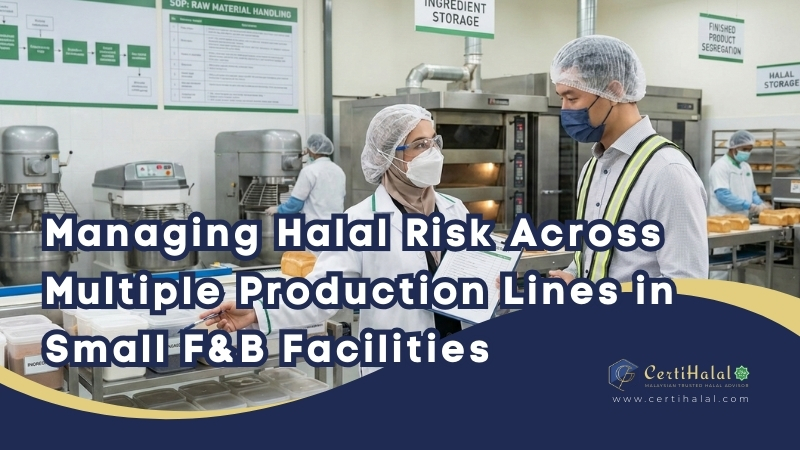
Managing Halal Risk Across Multiple Production Lines in Small F&B Facilities
Published on 25 February 2026Table of Contents
Building Halal Integrity Beyond a Single Production Flow
For many small and micro Food & Beverage manufacturers in Malaysia, expansion often begins with operational diversification — introducing additional recipes, variants, or production lines within the same facility. While this improves commercial agility, it simultaneously introduces a more complex Halal risk environment.
When multiple production lines operate within one premise, the probability of cross-contact, documentation gaps, raw material confusion, and traceability weaknesses increases significantly. For businesses considering certification under the Malaysian Halal framework, this complexity must be carefully managed through a structured Internal Halal Control System (IHCS) that meets the requirements of the Jabatan Kemajuan Islam Malaysia (JAKIM).
Halal certification is not merely about ingredient approval — it is about controlling risk at every stage of operation.
Understanding the Regulatory Foundation: MHMS 2020 and IHCS
Malaysia’s Halal certification system is governed by the Malaysian Halal Management System (MHMS 2020), which differentiates between:
- Halal Assurance System (HAS) – required for medium and large industries
- Internal Halal Control System (IHCS) – applicable to micro and small industries
Under the Malaysian Halal Management System 2020 (MHMS 2020), small F&B facilities must, at a minimum, establish:
- A documented Halal Policy
- A procedure for raw material control and/or Halal risk control
- A traceability procedure
Although IHCS is structurally lighter than the Halal Assurance System (HAS), it still demands systematic control over Halal risks across all operational flows — especially where multiple production lines exist.
Failure to properly segregate and control processes may result in Non-Conformance Reports (NCRs) during an audit.
Where Risk Emerges in Multi-Line Production Environments
Multiple production lines introduce layered risk across several operational dimensions. The risk landscape can be understood using a Cause → Risk → Control → Outcome framework.
1. Raw Material Misallocation
Cause: Shared storage areas serving multiple product lines.
Risk: Unapproved or unverified materials entering a Halal-certified line.
Control:
- Maintain a comprehensive Raw Material Masterlist.
- Label and segregate materials per production line.
- Verify supplier Halal status before every purchase.
Under MHMS 2020, raw material control is foundational. Every ingredient must be traceable, and no doubtful materials may be stored or used.
2. Cross-Contamination Between Lines
Cause: Shared equipment, shared utensils, or overlapping processing schedules.
Risk: Physical contamination or mixing of product variants.
Control:
- Identify and document each Halal Control Point (HCP).
- Implement cleaning verification procedures.
- Schedule production to avoid overlap.
- Clearly mark equipment allocation.
Even in facilities that process only Halal materials, improper segregation can trigger audit findings if the controls are not documented.
3. Inconsistent Process Documentation
Cause: Informal production adjustments between lines.
Risk: Inability to demonstrate compliance during a Halal audit.
Control:
- Document SOPs for each production line.
- Maintain batch records and formulation logs.
- Ensure traceability from ingredient intake to final distribution.
Under MHMS 2020, traceability must allow one step backwards (supplier) and one step forward (distribution).
4. Labelling and Product Identification Errors
Cause: Similar packaging across variants.
Risk: Incorrect Halal logo usage or misrepresentation.
Control:
- Standardise labelling verification procedure.
- Cross-check product names against certification scope.
- Maintain documented approval for all packaging artwork.
Improper logo placement can result in regulatory penalties.
Designing an Effective IHCS for Multi-Line Operations
For micro and small F&B facilities, IHCS should not be viewed as a simplified compliance checklist. It must function as a risk management framework tailored to operational reality.
An effective IHCS in a multi-line facility should include:
1. A Clear and Visible Halal Policy
The Halal Policy must reflect a commitment to compliance with JAKIM certification requirements and Malaysian Halal standards such as MS 1500.
It should be:
- Signed by top management
- Communicated to all staff
- Displayed within the facility
2. Production-Line-Specific Risk Mapping
Each production line should have:
- A simple process flow diagram
- Identified Halal Control Points (HCP)
- Documented control mechanisms
Even though IHCS does not require the full documentation depth of HAS, risk mapping is essential when operational flows differ.
3. Raw Material Masterlist Control
The Raw Material Masterlist must contain:
- Ingredient name
- Supplier details
- Halal certification status
- Expiry date of Halal certificate
- Supporting documents (CoA, MSDS where relevant)
This becomes critical when different lines use different ingredient combinations.
4. Traceability and Recall Readiness
Mock recall exercises are strongly encouraged for IHCS operators as well.
A functional traceability system ensures:
- Quick isolation of affected batches
- Controlled withdrawal if required
- Demonstrated audit preparedness
Traceability failures are among the most common weaknesses observed during Halal audits.
Common Blind Spots Small F&B Manufacturers Overlook
Many small operators assume that being “100% Halal ingredients only” automatically guarantees compliance. This is a misconception.
Key blind spots include:
- Informal supplier substitutions
- Inadequate record retention
- No designated Halal person-in-charge
- Lack of structured internal review
- Shared storage without documented segregation
Under MHMS 2020, the responsibility lies with the company to ensure continuous compliance — not only during the application but throughout the certification validity.
Moving from Compliance to Structured Risk Governance
Halal certification should not be approached as a one-time application process. It is a governance system that protects brand integrity.
A structured implementation approach for small facilities includes:
- Initial gap assessment against IHCS requirements
- Risk mapping across all production lines
- Documentation drafting and refinement
- Internal training and awareness sessions
- Pre-submission review before official audit
When implemented correctly, IHCS strengthens operational discipline beyond regulatory compliance.
The Strategic Value of a Certified Halal Advisory Partner
As a Ministry of Finance (MOF)-certified Bumiputera professional service provider and Certified Strategic Partner of MIHA under JAKIM, GGS Global Sdn Bhd works closely with small and emerging F&B manufacturers to translate regulatory requirements into practical operational systems.
For multi-line facilities, strategic advisory support ensures:
- Proper HCP identification
- Structured documentation development
- Risk mitigation across production overlaps
- Alignment with JAKIM audit expectations
- Reduced likelihood of NCR findings
Beyond certification readiness, GGS Global positions businesses to operate with long-term Halal governance confidence.
Reinforcing Malaysia’s Position as a Halal Benchmark
Malaysia’s Halal certification system, administered by JAKIM, is widely regarded as one of the most structured and credible globally. Even for domestically focused manufacturers, certification under MHMS 2020 enhances market trust and brand credibility.
For small F&B facilities operating multiple production lines, Halal risk must be proactively managed through disciplined IHCS implementation.
Halal integrity is not determined by intention — it is determined by documented control.
By adopting a structured Internal Halal Control System and partnering with experienced advisory professionals, small manufacturers not only achieve certification but also contribute to Malaysia’s broader ambition to maintain its standing as a global Halal benchmark.
Frequently Asked Questions (FAQs)
1. Does a small F&B manufacturer with multiple production lines require HAS or IHCS under MHMS 2020?
Under the Malaysian Halal Management System 2020 (MHMS 2020), micro and small industries are required to implement the Internal Halal Control System (IHCS), not the full Halal Assurance System (HAS).
However, when multiple production lines are involved, IHCS must still be structured, documented, and risk-based to ensure proper segregation and traceability across all operational flows.
2. What is the biggest Halal risk in facilities operating multiple production lines?
The most common risk is cross-contamination or misallocation of materials between production lines.
Shared storage, shared equipment, and informal material substitutions can introduce compliance gaps that may result in Non-Conformance Reports (NCRs) during audit by Jabatan Kemajuan Islam Malaysia (JAKIM).
3. Is it mandatory to identify Halal Control Points (HCP) under IHCS?
Yes. Even though IHCS is less complex than the full Halal Assurance System (HAS), businesses must still identify critical risk areas known as Halal Control Points (HCPs).
HCP identification ensures that:
- Risk areas are clearly mapped
- Controls are defined
- Staff understand prevention mechanisms
This becomes especially important in multi-line environments.
4. How should raw materials be managed when different production lines use different formulations?
A Raw Material Masterlist must be maintained and updated regularly.
It should include:
- Ingredient name
- Supplier details
- Halal certificate validity
- Supporting documentation (e.g. CoA, MSDS where applicable)
Segregation in storage and clear labelling per production line are essential to prevent misallocation.
5. Can small manufacturers share equipment between production lines?
Yes, but only if:
- Cleaning procedures are documented
- Cleaning effectiveness is verified
- Production schedules prevent overlap
- Risks are clearly mapped within the IHCS
Undocumented shared usage is a common audit weakness.
6. Is traceability required for micro and small F&B facilities?
Yes. IHCS requires a documented traceability procedure that enables:
- One step backwards (supplier identification)
- One step forward (distribution tracking)
In multi-line facilities, batch identification must clearly indicate which production line processed the product.
7. What documentation is minimally required under IHCS for Halal certification?
At a minimum, the company must establish:
- A documented Halal Policy
- Raw material control procedure and/or Halal risk control procedure
- Traceability procedure
Although IHCS is streamlined, documentation must reflect actual operational practice — particularly where multiple production flows exist.
8. How long does it typically take to prepare a small F&B facility for first-time Halal certification?
Preparation time varies depending on the documentation’s readiness and the operational complexity.
For facilities with multiple production lines, additional time is required for:
- Risk mapping
- SOP drafting
- Staff training
- Pre-audit review
Structured advisory support can significantly shorten preparation timelines.
9. What are common audit findings for small multi-line F&B operators?
Frequent NCR triggers include:
- Incomplete Raw Material Masterlist
- Expired supplier Halal certificates
- Undocumented production changes
- Lack of internal Halal awareness training
- Inconsistent product labelling
Most findings arise from weak documentation rather than intentional non-compliance.
10. Why should a small domestic-focused manufacturer pursue Halal certification?
Even for domestic-only operations, certification:
- Strengthens brand credibility
- Builds consumer trust
- Enhances operational discipline
- Positions the company for future export expansion
Working with a structured advisory partner such as GGS Global Sdn Bhd ensures alignment with regulatory expectations and reduces audit risk.